Posts

Authentic learning

Image
  The concept of authentic learning is more of a philosophy, that helps to provide a useful pedagogical guide and model for curriculum design rather than a learning theory (Herrington, 2015; Shaffer and Resnick, 1998).  Authentic learning is based on a constructivist view in which students create their own understandings of new concepts and practices by integrating their previous experience, the resources they have, their own research and their current experience (Roach et al, 2018). Shaffer and Resnick (1999) analysed the literature around  authentic education and found there to be four main identifiable kinds of authentic learning. They describe: (a) learning that is personally meaningful for the learner, (b) learning that relates to the real world out of school, (c) learning that provides opportunity to think in the modes of the particular discipline, and (d) learning where the means of assessment reflect the learning process (p.195).  They details around each kin...

TEXT: Argument

  What all of the literature has in common is that digital accessibility should not be a bolt on at the end, but instead be part of the process of creating materials with a understanding of user needs at the forefront. To get this right, awareness, education and training plays a vital part.   This research argues and promotes that because of our social responsibility for equality as a ‘digital by default’ society, the awareness and skills surrounding digital accessibility should be taught at the very point of learning about digital. This would help to ensure that these practices are established as the norm much earlier on, therefore not added as an extra or unpicked later on in life.  Exploring this in the primary school curriculum also means that this underpinning awareness and baseline knowledge can be brought into the mainstream for all of our future citizens in society. This would additionally help to address the added concerns that broader awareness around digital ac...

L2E curriculum structure like BBC Bitesize

Image
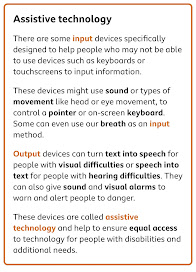
  Making digital content that works for everyone.   Sections like BBC Bitesize Digital accessibility and inclusive design  Digital content and user needs (age, sight, sound, touch, cognitive, range of places e.g. documents, presentations, social media, audio/visual) Laws for digital content (Web regs, WCAG, POUR principles, Equality Act reasonable adjustments, international) Assistive technologies (inputs/outputs, screen readers, the need to make content to work with these so people don’t have barriers) Digital tips to make content inclusive (12) Inclusive content in the workplace (examples from BLC/HOW Tutors/BDF) https://www.bbc.co.uk/bitesize/topics/zs7s4wx/articles/z7wckty Could also make the new section into pages like a Ladybird type book 🐞  E.g. rework like this: Assistive technology There are some  input  devices specifically designed to help people who may not be able to use devices such as keyboards or touchscreens to input information.  The...

TEXT: Add to intro

 Just after ‘there are studies about it in HE’ The studies that do currently explore the teaching of accessibility do so from within university education, the workplace or library information science. Many articles highlight that even after two decades of legal requirements and guidance such as WCAG (W3C, 1999; W3C, 2018), Section 508 and the ADA in the US (ref) or the last five years of the web regulations in the UK (Ref) awareness around digital accessibility is not common knowledge in the mainstream (Millikan and Djenno, 2017; Putnam, 2016; Ref), skills mainly sit within the web profession (Ref) but the skills in graduates for that profession are not meeting the demand in industry (Nicolle and Darzentas, 2019; Putnam, 2016, Teach Access, 2023; PEAT, YEAR; Nishchyk and Chen, 2018; Lewthwaite et al, 2020; Coverdale et al, 2022; Teach Access, 2023). The topic is not also widely disseminated or taught within the learning curriculum (Nishchyk and Chen, 2018; Kulkarni, 2018; Lewthwait...

BBC Bitesize key stage 2

Image
  https://www.bbc.co.uk/bitesize/levels/zbr9wmn Citizenship  https://www.bbc.co.uk/bitesize/topics/zfb7m39/articles/zvr2m39 https://www.bbc.co.uk/bitesize/topics/zfb7m39/articles/ztp496f Computing  https://www.bbc.co.uk/bitesize/topics/zs7s4wx/articles/zx8hpv4 Inputs and outputs mentions assistive technology  https://www.bbc.co.uk/bitesize/topics/zs7s4wx/articles/z7wckty Potential to make extra section about Making digital content inclusive - did you know . Use the boxes styling like the first image in this post. Refer in assistive technology section to ‘making inclusive content that works well for people who use screen readers’ PowerPoint as a prototype/pilot Three page PowerPoint to start with as a demo: P1 - Why we need to make things accessible, universal design principles and examples. Equality act and web regulations and how they help web designers. It’s not just web designers who can make accessible content, here are some tips to make you aware of the things w...

The IT2008 model curriculum

  https://www.laccei.org/LACCEI2009-Venezuela/Papers/CSI044_Ekstrom.pdf

Authentic learning theory

Image
  https://www.researchgate.net/profile/Marilyn-Lombardi/publication/220040581_Authentic_Learning_for_the_21st_Century_An_Overview/links/0f317531744eedf4d1000000/Authentic-Learning-for-the-21st-Century-An-Overview.pdf?origin=publication_detail https://www.researchgate.net/profile/Clif-Mims/publication/228395999_Authentic_Learning_A_practical_introduction_and_guide_for_implementation/links/0046352abc748a95f2000000/Authentic-Learning-A-practical-introduction-and-guide-for-implementation.pdf?origin=publication_detail https://f.hubspotusercontent40.net/hubfs/5726799/LearnLife_August2021/Pdf/e-Teaching_2016_10-1.pdf What is authentic learning? Authentic learning is learning designed to connect what students are taught in school to real-world issues, problems, and applications; learning experiences should mirror the complexities and ambiguities of real life. https://centaur.reading.ac.uk/92627/3/France,%20Mauchline%20et%20al.%20(Bilham%20et%20al.%202019,%20ch.%202).pdf https://link.spring...